
The residency: specialist training in practice
Specialist expertise develops through sustained, supervised practice. A residency brings a veterinarian and a specialist supervisor together in a structured training programme, connecting scientific knowledge with the judgement and skills needed to practise the discipline.
Lectures and courses support the training. Supervised professional practice is its foundation.
A training partnership
The resident
The resident actively participates in the work of the specialty, applies knowledge, explains decisions and develops practical skills. Reviewing that work with a supervisor creates opportunities to recognise gaps, respond to feedback and improve.
The specialist supervisor
The supervisor makes specialist reasoning visible, observes the resident’s work and provides challenge, guidance and feedback. Supervision supports learning while maintaining appropriate oversight of the resident’s professional responsibilities.
Progressive responsibility: as competence develops, the resident takes on greater responsibility with supervision matched to their capabilities and the demands of the work.
The residency route to specialisation
Build the foundations
At least one year of internshipStructured postgraduate training develops practical experience beyond the veterinary degree. A College may accept equivalent experience that meets its entry requirements.
Develop specialist competence
At least three years of residency trainingAn approved programme combines supervised practice, study, research and teaching. The work undertaken reflects the specialty, from clinical cases and diagnostic investigations to population health and other professional activities.
Demonstrate readiness
Credentials review and College examinationCandidates must demonstrate that they have met their College’s training and documentation requirements and pass its certifying examination. Completing a residency alone does not confer specialist status.
Different formats, shared standards
Standard residency
A College-approved programme lasting at least three consecutive years, with an established training structure, facilities and specialist supervision.
Alternate residency
An individually approved programme developed with the supervisor. It provides at least three years’ equivalent supervised training within six years, subject to approved extensions.
Flexible and modular pathways
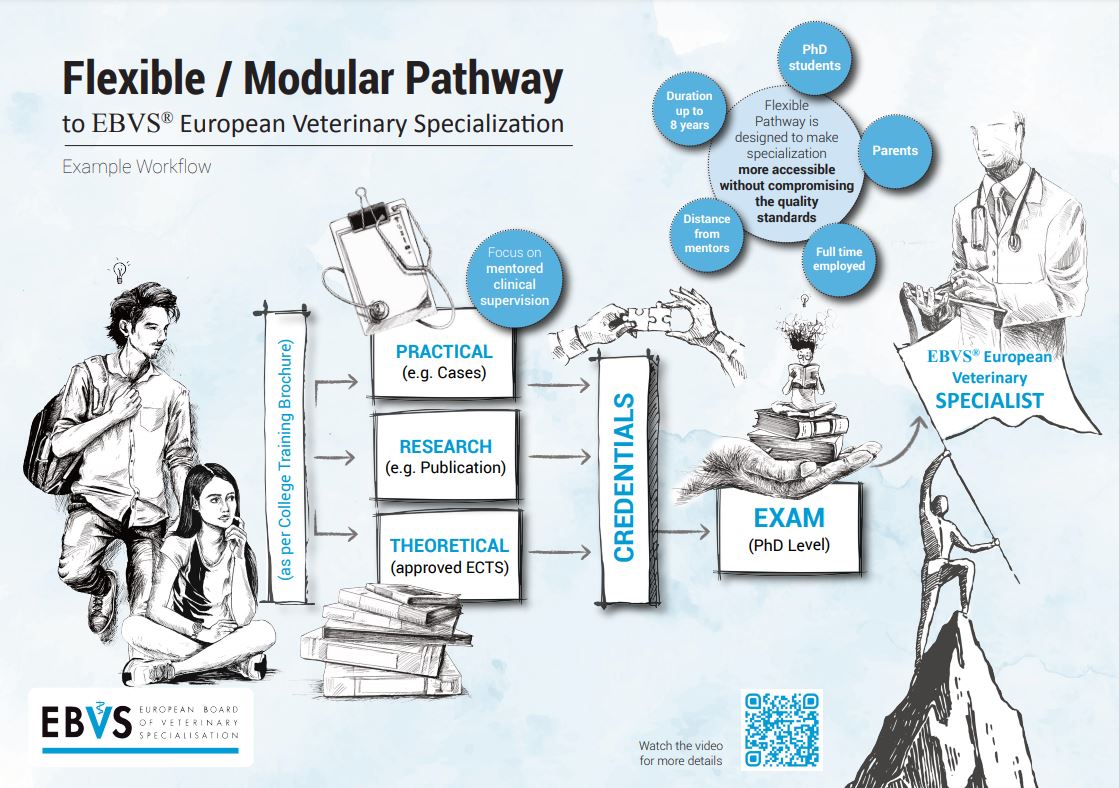
Colleges may also offer a credit-based route combining theoretical learning, supervised professional practice and research. This provides flexibility in how training is organised while retaining the required practical outcomes and the same final assessment.
Availability and detailed requirements are determined by the individual College.
EBVS, or the European Board of Veterinary Specialisation, is an organisation focused on the specific education and training required for veterinarians who want to practice as EBVS® European Veterinary Specialists in certain discipline.
Discover more about veterinary specialisation in various countries, or find specialist in your area.
The process of veterinary specialization
Veterinary specialist education and training takes at least 4 years after completing a veterinary degree. All EBVS Colleges share a common set of requirements for the specific education, training, and practice of the chosen veterinary discipline. This training is typically divided into two main phases - an internship and a residency.
An internship is the first stage of post-graduate training, not to be confused with general veterinary practice, and it lasts for at least one year before starting a residency. The residency, which is the next phase, is designed to offer in-depth education in the science and state-of-the-art practices of the selected veterinary discipline.
A residency program can follow a standard or alternate format and lasts for a minimum of thirty-six months. A Standard Residency is a pre-approved, post-graduate training program. Conversely, an Alternate Residency is a tailor-made, approved program for an individual candidate. Both standard and alternate residency programs have identical requirements for resident activities, documentation, and supervision by an EBVS Diplomate.
During the residency, a resident usually spends at least twenty-four months under the direct supervision of an EBVS College Diplomate. Candidates must complete their residency training within a maximum time limit of seven years. Learn more about internships and residencies in the different EBVS-recognised Colleges.
Flexible / Modular Pathways to Veterinary Specialization
The European Board of Veterinary Specialisation (EBVS) has introduced a new approach to veterinary specialization through a credit-based modular pathway to make specialization more accessible and flexible without compromising the quality standard. It's up to each speciality college to decide whether they adopt this approach. Discover more